Read any “best bistros in Paris” list, and you’re likely to find the same frequent fliers: Bistrot Paul Bert, Bistrot des Tournelles, Le Bon Georges, La Bourse et la Vie… And while I’m a guilty party in continuing to put these same names forward, I can’t help it. The reality is that so many bistros in Paris are disappointing, so it’s only natural that the few that aren’t appear again and again. So when I stumble upon an excellent bistro that hasn’t already been over-hyped from here to New York, I’m thrilled – and that’s precisely why I’m so glad to finally share Amarante with you.
Of course, Amarante is no secret to in-the-know diners. It’s been written up laudably in English by Alec Lobrano and Aaron Ayscough, not to mention French reviewers for Michelin and Gault & Millau. But it’s often overlooked on some of the more prominent lists, something that isn’t surprising to me given its menu’s focus on offal. But pay this bistro a visit, and even if you’re not a fan of organ meat, you’re sure to find your bliss.

The bistro is charmingly run by Christophe Philippe, who writes on the menu that his “whole life is devoted to it (literally).” A proponent of traditional home cooking and low-intervention wines, he does the cooking and takes the reservations – mainly by WhatsApp or text. My own experience reserving a table is perhaps the best illustration of just how undeniably human this bistro is.
I had originally texted asking to reserve a table for three people; I got a response that a table for two would be available at 7:30pm. When I asked for a table for three at 8pm instead, I was sent the following explanation (translated by me):
“The idea is that we’re a teeny tiny restaurant: 1 person on the floor, 1 assistant in the kitchen, and me. I organize the reservations to have progressive arrivals so that everything goes well for you and for me… (every table gets its turn). And with the price of gas tripling, I try to turn things off at 9pm to close at 11. (We’ve always only ever done one service, at any rate.)”
I loved everything about the message: the transparency and honesty, and above all the adherence to that old-school single service that once dominated a city that has since adopted that abhorrently American (yet, in this economy, wholly understandable) habit of flipping tables.

The old-school feel continues in the dining room, which looks straight out of the bistro playbook, with its mosaic tiled floor, red leather banquettes, and judiciously spaced dark wooden tables. I loved the small touches of luxury, like the heavy cotton napkins and framed artwork displayed throughout the room.
The menu itself is dominated by offal, and most diners here choose what have since become the stars: the butter-cooked veal’s brain (14), thinly sliced veal’s tongue (14), or crispy Kintoa pig’s foot (15) as starters followed by the whole butter-roasted veal sweetbread with mashed potatoes (42) as a main. And while I was sorely tempted by the latter, I was also curious to see what else Philippe could do.

My girlfriend is a pescatarian, so she had far less choice than the rest of us. She started with a perfectly fine but slightly underseasoned lentil velouté (10) which seemed to be mixed with watercress. It was improved by the crusty sourdough loaf, but nothing to write home about.

I decided to try the house terrine (14) made with Kintoa pork and served with two fat French cornichons. This terrine was a bit denser and meatier than I’m used to, with perhaps a bit less fat than most. The porky flavor was incredibly present and not overpowered by spirits or herbs, and the homey plating was refreshing in its simplicity.

The winning appetizer, however, was the Nantaise “triple zero” shrimp, which were served with toast and salad (19).

This tartare was bright and briny, with a lovely textural contrast between cooked and raw shrimp, some of which were minced quite finely and others of which were studded through the mix in plump, toothsome chunks. It was creative and absolutely delicious.

My friend ordered the veal blanquette-style with chestnuts and knepfle, a buckwheat dumpling from Alsace (34). The veal was cooked to a rosy pink hue and served in a very thick sauce that bordered on overwhelming. The flavor of the meat was nevertheless excellent, and when my friend couldn’t finish it, our server gamely packaged the rest in a cardboard container to go.

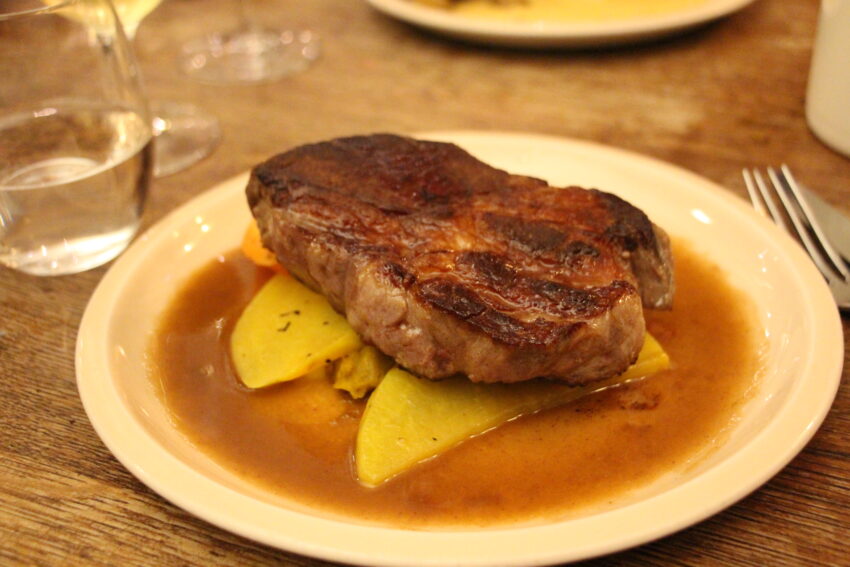
I ordered the butter-grilled Aldudes pork chop (32), which was, quite frankly, the best pork chop I’ve ever had. The outside as perfectly charred; the inside rosy and juicy. The seasoning was on-point, and the seasonal root vegetables with which it was served were cooked al dente, providing a touch of freshness in contrast with the rich, fatty meat.

It could have been the winning dish, if not for the underdog: the skate wing brandade (28), presented in a copious portion of three cakes shot through with roasted garlic and accompanied by salad. The flavors and textures were positively perfect, and while they were perhaps a touch too heat-kissed, overall, this constituted the most exemplary brandade I’ve ever had.

Desserts number three, and all are advertised as somewhere between “not very sweet” and “very very not sweet.” While all were tempting, I can never say no to lemon (12), which here is a mashup between a lemon curd and a crème brulée. It’s served in an extremely diminutive portion (a good idea, given how copious the mains are).

The curd itself is almost unsweetened, with a bright, almost bitter aromatic note. The only note of sweetness comes from the extremely burnished sugar crust, delivering on its low-sugar promise.
On the night of our visit, the dining room was nearly empty, and given the heart and soul that beat in every mouthful, this left me profoundly sad. I wish more people knew about this phenomenal little restaurant, and I hope to return myself soon.
Amarante – 4 rue Biscornet, 75012